
Quad-Ring
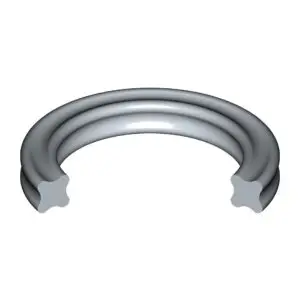
Quad Ring(X-Ring) is normally used for dynamic sealing applications (rotary or linear movement).
Table of content
- Quad Ring Material Selection
- Quad-Ring Size Calculation
- Working Temperature Range
- Chemical Resistance
- Quad-Ring Lubrication
- Quad-Ring Color
- Typical Applications
Quad Ring Material Selection

Working Temperature Range
Temperature range : –50°C to 200°C, depanding on the rubber material used.
Chemical Resistance
| Chemical Resistance of EPDM Rubber | |||||
| Chemical Type | Examples | Concentration | Temperature Limit | Resistance Rating | Notes |
| Inorganic Acids | |||||
| Sulfuric Acid (H₂SO₄) | Dilute | ≤70% | ≤60°C | Good | Avoid >70% concentration or >80°C (swelling/degradation). |
| Hydrochloric Acid (HCl) | Dilute | ≤30% | ≤60°C | Good | >30% or >80°C causes corrosion. |
| Nitric Acid (HNO₃) | Dilute | ≤10% | ≤50°C | Moderate | >10% or >50°C leads to rapid oxidation. |
| Phosphoric Acid (H₃PO₄) | All | Any | ≤100°C | Excellent | Full concentration range tolerated. |
| Organic Acids | Acetic Acid, Citric Acid | <30% | ≤80°C | Good | High concentrations (>30%) or >80°C may cause swelling. |
| Alkaline Media | |||||
| Sodium Hydroxide (NaOH) | ≤50% | ≤100°C | Excellent | >50%: Limit to ≤80°C. | |
| Potassium Hydroxide (KOH) | ≤50% | ≤100°C | Excellent | Slight hardening at >120°C. | |
| Ammonia (NH₃·H₂O) | Any | ≤80°C | Excellent | Suitable for full concentration range. | |
| Oxidizing Agents | |||||
| Hydrogen Peroxide (H₂O₂) | ≤30% | ≤60°C | Moderate | >30% concentration or >60°C accelerates aging. | |
| Ozone (O₃) | All | Any | Excellent | Exceptional ozone resistance (ideal for outdoor use). | |
| Sodium Hypochlorite (NaClO) | ≤15% | ≤25°C | Moderate | >15% concentration or high temperatures cause cracking. | |
Quad-RING Size Calculation
The selection of X-rings primarily depends on compression ratio because it directly impacts the sealing performance, durability.
Formula for Compression Ratio
The compression ratio (C) of an O-ring is calculated using the following equation:
C=(CS−Gd)/CS × 100%
Where:
CS = Cross-sectional diameter of the O-ring (mm or inches)
Gd = Groove depth (mm or inches)
Acceptable Compression Ratio Guidelines
| Application Type | Recommended Compression Ratio | |
|---|---|---|
| Static Seals | 15% – 25% | |
| Dynamic Seals | 10% – 15% | |
| High-Pressure Seals | 20% – 25% |
Quad-Ring Size Standard
| Standard System | Typical ID Range | Common CS (mm) |
| AS568 | 1.02 mm ~ 1000 mm | 1.78, 2.62, 3.53 |
| ISO 3601 | 1 mm ~ 1000 mm | 1.5, 2.4, 3.0 |
| JIS B2401 | 6 mm ~ 600 mm | 1.9, 2.4, 3.1 |
Quad-Ring Lubrication
Surface coatings are applied to O-rings to enhance their performance in demanding applications. The primary purposes include:
Friction Reduction: Minimize assembly force.
Chemical Resistance: Protects against aggressive media (acids, solvents, fuels).
Coating Materials
| Coating Material | Key Properties | Color |
|---|---|---|
| PTFE (Polytetrafluoroethylene) | – Ultra-low friction (μ ≈ 0.05–0.1) – Chemical inertness – Temp range: -60°C to +260°C | Light white |
| Lubricate FP(PFPE based lubricating fluid) | – Low friction – Prevent the O-rings from twisting – Compatible with cleanness requirements – NO impact on the mechanical properties of the rubber | Transparent |
| Molybdenum Disulfide (MoS₂) | – Low friction – Anti-galling | Dark grey |
Quad-Ring Color
Black is normally used. Please contact with us if different color is needed.
Typical Applications
- Automotive – Valves
- Industrial Pumps and Motors
- Hydraulic Systems
Thanks to contact us to discuss your requirements regarding Quad-RINGs. We are ready to assist you with fast, reliable support.