
FKM O-Ring
FKM (Viton) rubber is widely used in automotive engine and fuel systems because of its good resistance to oil, high temperature.
Table of content
- FKM (Viton) Material Property
- O-RING Size Calculation
- Working Temperature Range
- Chemical Resistance
- O-Ring Lubrication
- O-Ring Color
- Typical Applications
FKM (Viton) Material Property
| Characteristic | Unit | Test method | Standard range | Typical value |
| Physical properties | ||||
| Hardness Shore A | Point | ASTM D2240 | 70±5 | 72 |
| Tensile strength | MPa | ASTM D412 | ≥10 | 14 |
| Elongation at break | % | ASTM D412 | ≥150 | 210 |
| Comprehension set 70h at 200℃ | % | ASTM D 395 | ≤25 | 23 |
| Low temperature properties Tg by DSC | ℃ | ASTM D3418 | ≤-15 | -17 |
| Fluid resistance | ASTM D471 | |||
| Volume change after 70h at 150℃ in | % | |||
| – Oil 901 | 0/+8 | 1 | ||
| – Oil 902 | 0/+8 | 1 | ||
| – Oil 903 | 0/+8 | 3 | ||
| Volume change after 70h at 150℃ in | % | |||
| – Liquid A | ||||
| – Lquid B | 0/+8 | 1 | ||
| – Liquid C | 0/+8 | 2 | ||
| 0/+8 | 4 |
Working Temperature Range
Temperature range : –20°C /-40°C to 200°C
Low temperature performance of FKM(Viton) is poor, special application may need low temperature FKM material with higher cost.
Chemical Resistance
| Chemical | Resistance Rating | Temperature Range | Notes |
|---|---|---|---|
| Acetone | Poor | Up to 100°C | Limited resistance; avoid prolonged exposure. |
| Methanol | Good | Up to 150°C | Suitable for intermittent contact. |
| Hydrochloric Acid (10%) | Fair | Up to 80°C | Avoid high concentrations and elevated temperatures. |
| Sulfuric Acid (50%) | Good | Up to 120°C | Resistant to diluted solutions; avoid concentrated forms. |
| Diesel Fuel | Excellent | Up to 200°C | Highly resistant to hydrocarbons and fuels. |
| Hydraulic Oils | Excellent | Up to 200°C | Compatible with most mineral and synthetic oils. |
| Ammonia (aqueous) | Poor | Up to 60°C | Poor resistance; degradation occurs rapidly. |
| Ethylene Glycol | Excellent | Up to 150°C | Resistant to antifreeze and coolant fluids. |
| Benzene | Good | Up to 150°C | Limited swelling; suitable for short-term exposure. |
| Sodium Hydroxide (30%) | Fair | Up to 80°C | Avoid prolonged exposure to strong alkalis. |
| Chlorinated Solvents | Poor | Up to 60°C | Severe swelling and chemical attack (e.g., dichloromethane, chloroform). |
| Ozone | Excellent | Up to 200°C | Outstanding resistance to oxidation and ozone. |
O-RING Size Calculation
The selection of O-rings primarily depends on compression ratio because it directly impacts the sealing performance, durability.
Formula for Compression Ratio
The compression ratio (C) of an O-ring is calculated using the following equation:
C=(CS−Gd)/CS × 100%
Where:
CS = Cross-sectional diameter of the O-ring (mm or inches)
Gd = Groove depth (mm or inches)
Acceptable Compression Ratio Guidelines
| Application Type | Recommended Compression Ratio | |
|---|---|---|
| Static Seals | 15% – 30% | |
| Dynamic Seals | 10% – 20% | |
| High-Pressure Seals | 20% – 30% |
O-Ring Lubrication
Surface coatings are applied to O-rings to enhance their performance in demanding applications. The primary purposes include:
Friction Reduction: Minimize assembly force.
Chemical Resistance: Protects against aggressive media (acids, solvents, fuels).
Coating Materials
| Coating Material | Key Properties | Color |
|---|---|---|
| PTFE (Polytetrafluoroethylene) | – Ultra-low friction (μ ≈ 0.05–0.1) – Chemical inertness – Temp range: -60°C to +260°C | Light white |
| Lubricate FP(PFPE based lubricating fluid) | – Low friction – Prevent the O-rings from twisting – Compatible with cleanness requirements – NO impact on the mechanical properties of the rubber | Transparent |
| Molybdenum Disulfide (MoS₂) | – Low friction – Anti-galling | Dark grey |
O-Ring Color
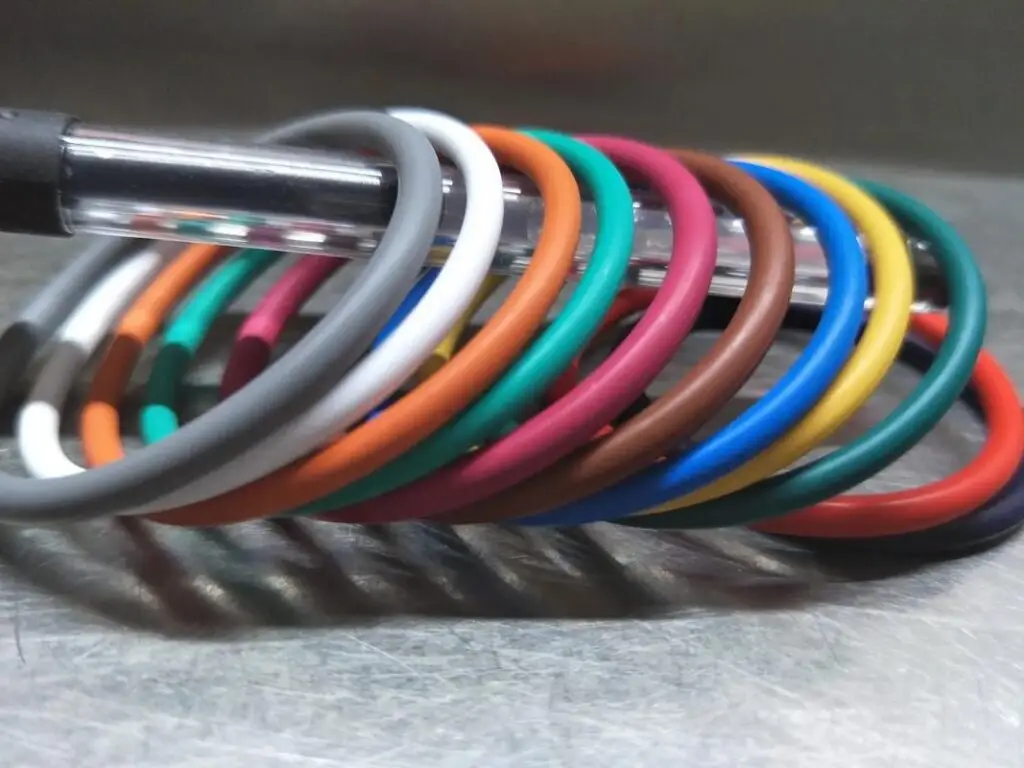
Different color can be chosen for easlier identification.
- Black
- Blue
- Green
- White
- Red
Typical Applications
- Automotive – Engine System
- Automotive – Fuel System
- Semi-conductor Industry
- Oil&Gas Industry
Thanks to contact us to discuss your requirements regarding O-RINGs. We are ready to assist you with fast, reliable support.