
AEM O-Ring Seals for High-Temperature ATF Oil Resistance
Precision-engineered AEM O-Rings manufactured from ethylene acrylate elastomer.
Combining 175°C heat resistance with superior ATF and oil compatibility,
our AEM seals outperform HNBR at elevated temperatures while offering a cost-effective alternative to FKM.
What Is an AEM O-Ring?
AEM (Ethylene Acrylate Elastomer) is a synthetic rubber copolymer of ethylene
and methyl acrylate, reinforced with a cure-site monomer for peroxide or amine crosslinking.
Originally developed by DuPont under the Vamac® trade name, AEM occupies the performance
space between HNBR and FKM — delivering better heat resistance
than hydrogenated nitrile, better oil resistance than EPDM, and a more economical price point than fluoroelastomers.
OTE’s AEM O-Rings are molded from a fully characterized
formulation verified through ISO-compliant laboratory testing. Every batch is tested for
physical properties, heat aging performance, fluid compatibility, and low-temperature behavior
before release.
Key advantage: AEM delivers reliable sealing in automatic transmission
and power steering systems where HNBR O-rings degrade prematurely from heat and FKM O-rings
represent unnecessary cost.
Why Choose AEM O-Rings for Your Application
AEM is purpose-engineered for sealing applications where heat, oil, and cost converge — delivering measurable advantages over traditional rubber compounds.
175°C Heat Resistance
After 168 hours at 175°C (ISO 188), AEM shows only +5 Shore A hardness change and -10.2% tensile change — maintaining sealing force in high-temperature environments where HNBR would harden and fail.
Superior ATF & Oil Compatibility
Tested in FUCHS 4101 oil at 150°C for 1,008 hours (ISO 1817), AEM exhibits just +6.2% volume change — well within industry limits. Excellent resistance to automatic transmission fluids, power steering fluids, and mineral oils.
-28°C Low-Temperature Flexibility
TR10 of -28°C (ISO 2921) ensures AEM O-Rings maintain elasticity during cold-start conditions. Unlike FKM compounds that stiffen below -15°C, AEM retains sealability in winter operating environments.
Long-Term Aging Stability
Extended 1,008-hour heat aging at 150°C demonstrates only -25.6% tensile change and +4.8% elongation change — confirming AEM’s suitability for continuous high-temperature service over the full component lifecycle.
AEM TG7001 — Complete Test Data (Report No. 25/001)
All tests conducted on S2 dumbbell specimens. GB test methods have been cross-referenced to their ISO equivalents for international customers.
| # | Property | Unit | Test Method (ISO) | Specification | Measured Value |
|---|---|---|---|---|---|
| Physical Properties | |||||
| 1 | Density | g/cm³ | ISO 2781 | — | 1.48 |
| 2 | Hardness | Shore A | ISO 48-4 | 70 ±5 | 69 |
| 3 | Tensile Strength | MPa | ISO 37 | ≥ 8 | 10.2 |
| 4 | Stress at 100% Elongation | MPa | ISO 37 | — | 4.1 |
| 5 | Elongation at Break | % | ISO 37 | ≥ 100 | 203 |
| 6 | Tear Strength | kN/m | ISO 34-1 | ≥ 15 | 18.42 |
| Heat Aging — 175°C × 168 hours (ISO 188) | |||||
| 7 | Hardness Change | % | ISO 188 | -5 to +10 | +5 ✓ |
| 8 | Tensile Strength Change | % | ISO 188 | ≥ -40 | -10.2 ✓ |
| 9 | Elongation Change | % | ISO 188 | ≥ -45 | +1.5 ✓ |
| 10 | Compression Set | % | ISO 815-1 | ≤ 60 | 29.7 ✓ |
| Heat Aging — 150°C × 1,008 hours (ISO 188) | |||||
| 11 | Hardness Change | % | ISO 188 | -5 to +10 | +8 ✓ |
| 12 | Tensile Strength Change | % | ISO 188 | ≥ -40 | -25.6 ✓ |
| 13 | Elongation Change | % | ISO 188 | ≥ -45 | +4.8 ✓ |
| Oil Resistance — FUCHS 4101, 150°C × 168 hours (ISO 1817) | |||||
| 14 | Hardness Change | % | ISO 1817 | -15 to +5 | -4 ✓ |
| 15 | Tensile Strength Change | % | ISO 1817 | ≥ -30 | -9.4 ✓ |
| 16 | Elongation Change | % | ISO 1817 | ≥ -60 | -11.5 ✓ |
| 17 | Volume Change | % | ISO 1817 | -5 to +15 | +3.2 ✓ |
| Oil Resistance — FUCHS 4101, 150°C × 1,008 hours (ISO 1817) | |||||
| 18 | Hardness Change | % | ISO 1817 | -10 to +10 | -8.2 ✓ |
| 19 | Tensile Strength Change | % | ISO 1817 | ≥ -30 | -18.5 ✓ |
| 20 | Elongation Change | % | ISO 1817 | — | -19.3 |
| 21 | Volume Change | % | ISO 1817 | -5 to +15 | +6.2 ✓ |
| Low Temperature & Environmental Resistance | |||||
| 22 | TR10 | °C | ISO 2921 | ≤ -20 | -28 ✓ |
| 23 | Ozone Resistance (50 pphm, 40°C, 20% elongation, 72h) | — | ISO 1431-1 | No cracks | No cracks ✓ |
* Original test methods per Chinese GB standards cross-referenced to ISO equivalents:
ISO 2781 ← GB/T 533 (Density) | ISO 48-4 ← GB/T 531.1 (Hardness) |
ISO 37 ← GB/T 528 (Tensile) | ISO 34-1 ← GB/T 529 (Tear) |
ISO 188 ← GB/T 3512 (Heat Aging) | ISO 1817 ← GB/T 1690 (Fluid Resistance) |
ISO 2921 ← GB/T 7758 (TR Test) | ISO 1431-1 ← GB/T 7762 (Ozone)
Report No. 25/001 | Compound: AEM TG7001 | Reference: LF70GJ025001 | Specimen: S2
AEM vs. HNBR vs. FKM vs. EPDM — O-Ring Material Comparison
Choosing the right O-ring material depends on temperature, fluid exposure, and cost. AEM fills the critical gap between HNBR and FKM.
| Property | AEM ★ | HNBR (Hydrogenated Nitrile) | FKM (Viton®) | EPDM |
|---|---|---|---|---|
| Max Continuous Temp | 175°C | 130–150°C | 200–230°C | 130–150°C |
| Low Temp Limit | -28°C | -30 to -40°C | -10 to -20°C | -40 to -55°C |
| Oil / Fuel Resistance | ★★★☆ | ★★★★☆ | ★★★★★ | ★☆☆☆ |
| ATF Compatibility | ★★★★★ | ★★★☆☆ | ★★★★★ | ★☆☆☆☆ |
| Ozone / Weather Resistance | ★★★★★ | ★★★★☆ | ★★★★★ | ★★★★★ |
| Compression Set Resistance | ★★★☆☆ | ★★★★☆ | ★★★★☆ | ★★★☆☆ |
| Relative Cost | $$ | $$ | $$$$ | $ |
| Best Application | Hot oil, ATF, transmission | Oil-resistant, general purpose | Aggressive chemicals, fuel | Water, steam, brake fluid |
Where AEM O-Rings Deliver the Most Value
The unique combination of heat resistance, oil compatibility, and cost-effectiveness makes AEM the optimal seal material for these applications.
🚗 Automatic Transmission Systems
AEM O-Rings are the industry standard for ATF sealing in automatic transmissions. With minimal volume change (+3.2%) in FUCHS 4101 at 150°C, AEM ensures consistent seal compression throughout the transmission’s service life.
🔧 Power Steering Systems
High-temperature power steering fluid compatibility combined with low compression set makes AEM the preferred seal material for rack-and-pinion steering and hydraulic power steering pump O-rings.
🔥 Turbocharger Oil Seals
Withstanding the extreme heat of turbocharger applications (up to 175°C peak), AEM maintains elasticity and seal integrity where HNBR O-rings would harden, crack, and leak.
🏭 Diesel Engine Sealing
Heavy-duty diesel engines operate at elevated temperatures with aggressive crankcase gases. AEM O-Rings provide reliable sealing for oil cooler connections, EGR system seals, and valve cover gaskets.
⚙️ Industrial Hydraulic Systems
High-temperature hydraulic oil applications in injection molding machines, die-casting equipment, and industrial presses benefit from AEM’s oil compatibility and temperature range.
🔬 Laboratory & Test Equipment
Ozone and weathering resistance makes AEM suitable for outdoor and exposed sealing applications in environmental test chambers, emissions testing equipment, and analytical instruments.
OTE O-Ring Manufacturing — Speed, Precision, Flexibility
From prototype to production, OTE’s O-Ring manufacturing capabilities are built around three principles: fast turnaround, small-batch flexibility, and zero-defect quality.
2-Week Rapid Tooling
Custom O-Ring mold tooling completed in 2 weeks — significantly faster than the industry average of 4–6 weeks. In-house CNC mold fabrication eliminates outsourcing delays, enabling you to move from drawing to first article samples in as little as 14 days.
Small-Batch & Prototype Support
No minimum order quantity on stock sizes. Custom compounds available from 100 pieces per batch. We support prototyping, pilot runs, and low-volume production with the same attention to quality as high-volume orders — no project too small.
Multi-Material & Color Options
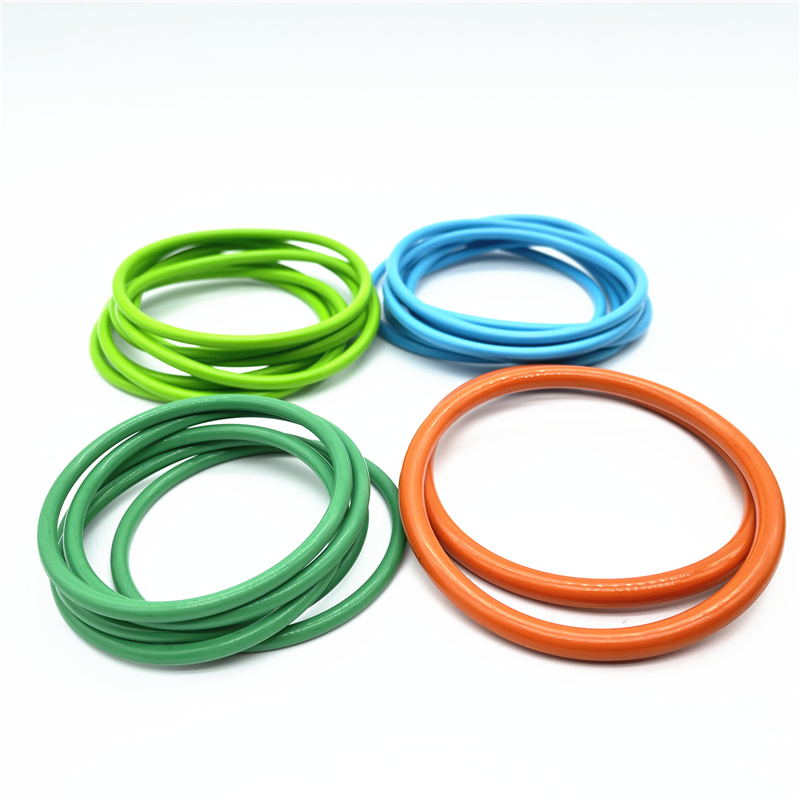
O-Rings available in AEM, FKM, FFKM, HNBR, NBR, EPDM, VMQ (Silicone), CR, and SBR. Standard colors include black, green, brown, red, white, and translucent. Custom color matching available for OEM branding or application-specific identification requirements.
100% Optical Inspection
Every O-Ring produced passes through our automated optical sorting and inspection system — the industry’s most advanced quality control technology. The system inspects 100% of parts for surface defects, dimensional accuracy, burrs, and contamination at high speed, ensuring zero-defect delivery to your production line.
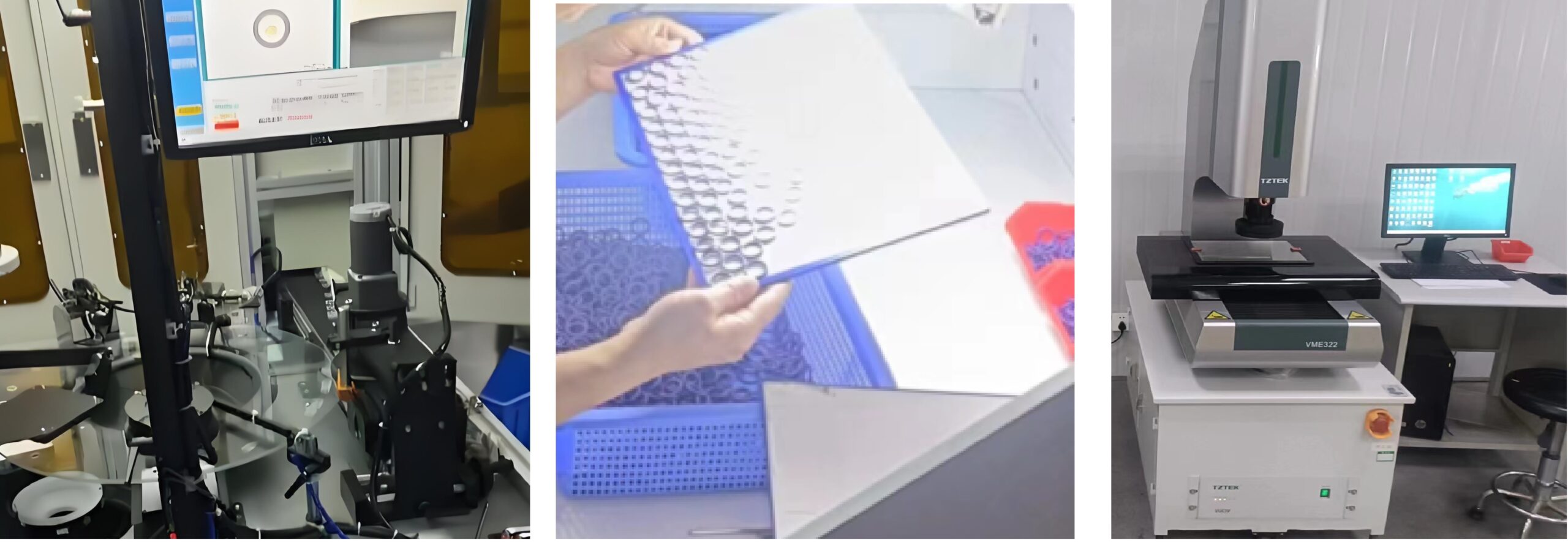
Automated optical sorting and inspection system — 100% surface defect, dimensional, and contamination inspection for every O-Ring produced