Custom Rubber Magnets: Flexible Magnetic Solutions
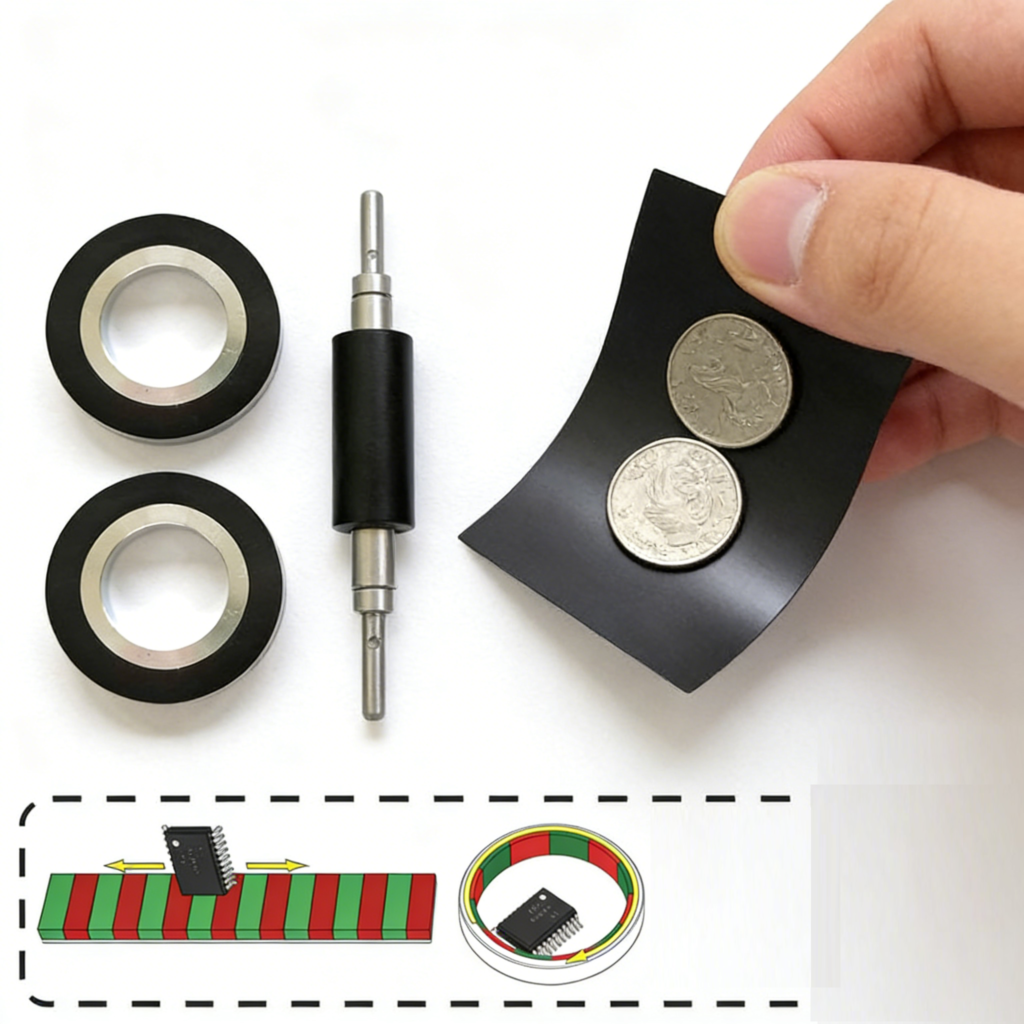
Rubber magnets are a versatile magnetic material solution that combines magnetic functionality with mechanical flexibility. Unlike traditional rigid magnets (such as ferrite magnets or NdFeB), these rubber-based magnets can bend, are easy to machine, resist vibration and shock, while maintaining reliable magnetic performance.
Rubber magnets are composite materials made by embedding magnetic particles into a flexible rubber matrix. This unique structure allows them to be cut, shaped, and molded into virtually any form, making them widely used across industries ranging from automotive to consumer electronics.
What Are Custom Rubber Magnets?
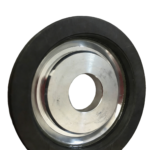
Custom rubber magnets are permanent magnetic materials manufactured by mixing magnetic powders—typically strontium or barium ferrite, and in some cases NdFeB—with a rubber polymer binder such as NBR (nitrile rubber). The resulting composite combines permanent magnetism with excellent flexibility, elasticity, and twistability.
Rubber magnets can be produced through compression molding and vulcanization processes to create pure rubber magnets, or they can be bonded to metal for broader applications. The surface can also be customized with PVC lamination, double-sided tape, UV coating, or full-color printing.
Different Types of Rubber Magnets
Ferrite Rubber Magnets
Ferrite rubber magnets are the most common and cost-effective type of flexible magnets. They’re made by mixing ferrite magnetic powder (SrO·6Fe₂O₃) with rubber or plastic binders.
Key characteristics:
Excellent corrosion resistance—no additional coating needed
Cost-effective for high-volume applications
Good temperature stability (ferrite material itself up to 250°C)
Surface field strength typically between 50 and 1,000 Gauss
Isotropic Rubber Magnets
Isotropic rubber magnets are magnetized uniformly in all directions, meaning there’s no preferred orientation of the magnetic domains. During manufacturing, the magnetic powder isn’t aligned in a magnetic field, so the magnetic properties are equal in every direction.
Characteristics:
Lower magnetic strength compared to anisotropic versions
Energy product typically between 0.60~1.50 MGOe
Can be magnetized after molding
Typical applications: Refrigerator magnets, printed promotional items, automotive stickers, educational materials, and general-purpose holding applications.
NdFeB Rubber Magnets
For applications requiring higher magnetic strength than ferrite can provide, NdFeB rubber magnets offer an enhanced solution. These magnets incorporate NdFeB magnetic powder into the rubber matrix, delivering stronger magnetic performance while maintaining flexibility.
Key advantages:
Higher magnetic strength than ferrite-based rubber magnets
Suitable for specialized industrial applications where space is limited but holding force requirements are demanding
Isotropic vs. Anisotropic Rubber Magnets
Understanding the difference between isotropic and anisotropic rubber magnets is crucial for proper material selection:
| Property | Isotropic Rubber Magnets | Anisotropic Rubber Magnets |
|---|---|---|
| Magnetic Orientation | Random, equal in all directions | Directionally aligned during manufacturing |
| Magnetic Strength | Lower | Higher (can be 2-3x stronger) |
| Manufacturing Process | Formed without magnetic field | Magnetic field applied during extrusion/calendering |
| Magnetization Method | Can be magnetized after forming | Must be magnetized in oriented direction |
| Typical Applications | Refrigerator magnets, printed promo items, general holding | Motors, sensors, precision applications |
| Cost | Lower | Higher |
For applications requiring maximum magnetic performance in a given volume, anisotropic rubber magnets are the preferred choice. For applications needing uniform magnetic field distribution, isotropic versions may be more suitable.
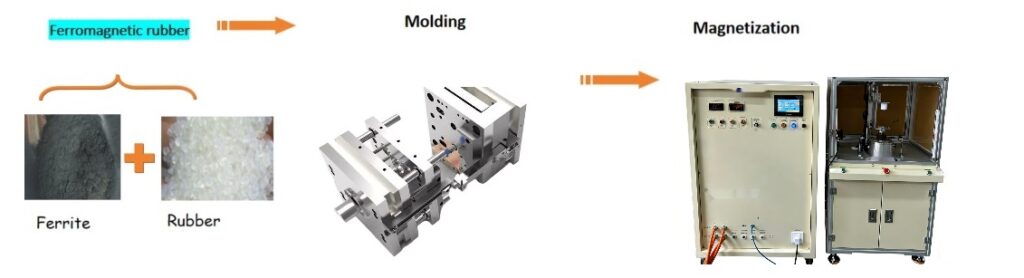
Manufacturing Process for Custom Rubber Magnets
The production of custom rubber magnets involves several key steps that directly impact final product quality:
1. Raw Material Selection & Mixing
The process starts with precise formulation:
Magnetic powder (ferrite or NdFeB) is mixed with rubber polymer in exact ratios
Material mixing in internal mixers ensures uniform dispersion of magnetic powder
2. Forming/Molding
Specialized molds are developed based on required product design, using compression molding (vulcanization) processes to form the product.
3. Magnetization
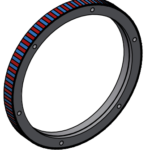
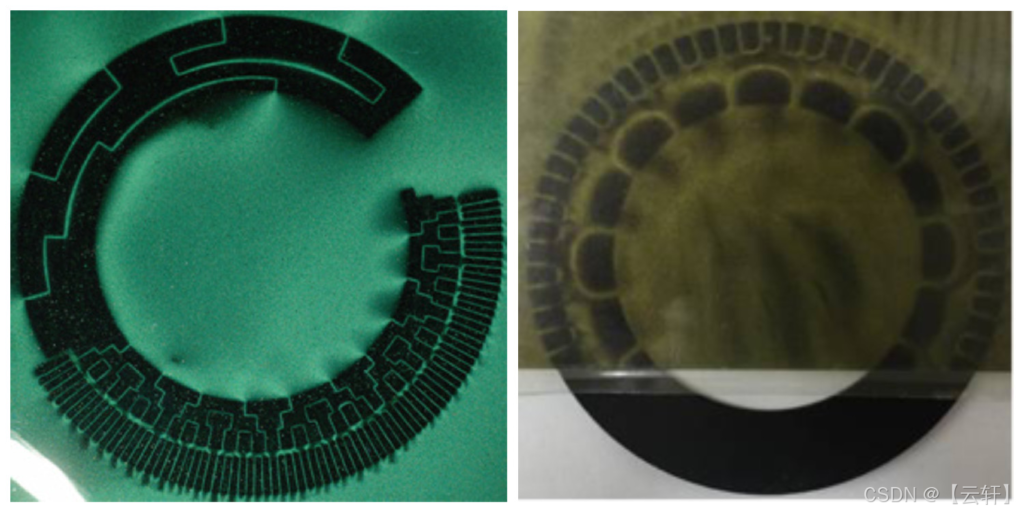
Products are magnetized using pulse magnetizing equipment. Common magnetization patterns include:
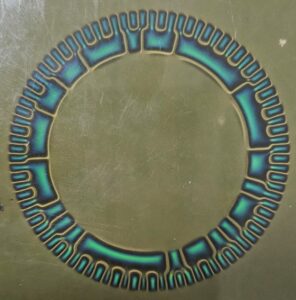
Single-side multi-pole: Multiple pole pairs, commonly used in sensing systems with Hall or magnetoresistive technology
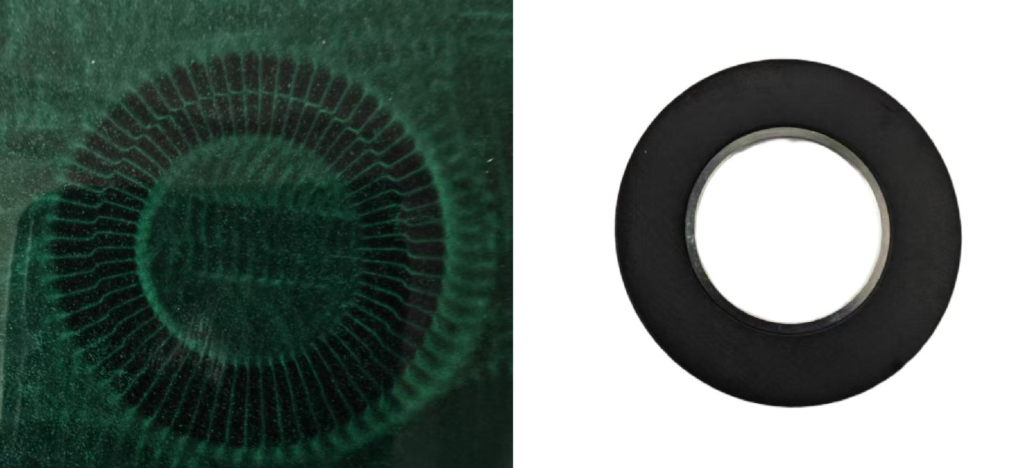
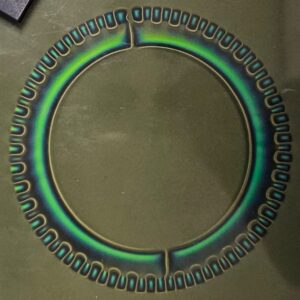
Radial magnetization: For motor rotors and applications requiring circumferential magnetic fields
Custom magnetization: According to customer requirements
Key Parameters of Rubber Magnets and Their Performance Impact
The performance of rubber magnets is determined by several key parameters working together. Understanding what these parameters mean and how they interact is essential for selecting the right material for your specific application. Here’s an analysis of the main performance parameters and their impact on usability:
1. Magnetic Parameters
1. Remanence Br
Definition: Remanence is the magnetic induction remaining in the magnet after saturation magnetization when the external magnetic field is removed, measured in Tesla (T) or Gauss (Gs). It reflects the magnetic field strength the magnet can maintain on its own.
Typical Range: Rubber magnets typically have remanence between 160-260 mT, depending on magnetic powder type and content.
Performance Impact:
Remanence directly determines the magnetic field strength on the magnet surface
Higher remanence means greater static attraction to ferromagnetic materials
At the same volume, materials with higher remanence provide stronger holding force
2. Coercivity Hcb and Hcj
Hcb (Magnetic Coercivity): The reverse magnetic field strength required to reduce the magnetic induction to zero, measured in kA/m or kOe
Hcj (Intrinsic Coercivity): The reverse field strength required to reduce the magnetization to zero, reflecting the magnet’s resistance to demagnetization
Typical Range: Rubber magnets typically have coercivity in the 200-280 kA/m range.
Performance Impact:
Higher coercivity means better resistance to external reverse magnetic fields and accidental demagnetization
In dynamic applications like motors and sensors, high coercivity ensures stability in alternating magnetic fields
Coercivity decreases at high temperatures, so high-temperature applications require materials with higher initial coercivity
3. Maximum Energy Product (BH)max
Definition: Energy product measures the energy density stored in the magnet, expressed in MGOe (Mega-Gauss-Oersted) or kJ/m³. It represents the maximum magnetic field energy the magnet can generate in the air gap.
Typical Range: Rubber magnets typically have energy products between 0.6–1.6 MGOe.
Performance Impact:
Higher energy product means stronger holding force at the same volume
Energy product is a core comprehensive indicator of magnetic performance, considering both remanence and coercivity
For applications requiring high holding force in space-constrained environments, prioritize materials with high energy product
4. Surface Magnetic Flux Density
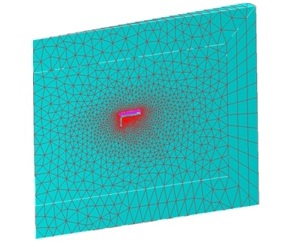
Definition: The magnetic induction at specific positions on the magnet surface, measured in Gauss (Gs) or milliTesla (mT).
Typical Data (reference only):
Surface Flux (mT)=20-50, Air gap=1mm,Thickness (mm) =1mm
Performance Impact:
Surface flux density directly determines the magnet’s magnetic holding capacity
Increases with thickness, but the rate of increase gradually slows
5. Remanence Temperature Coefficient αBr
Definition: The remanence temperature coefficient indicates how remanence changes with temperature, expressed in %/K (or %/°C). It reflects the stability of magnetic performance during temperature changes.
Typical Value: Rubber magnets typically have a remanence temperature coefficient around -0.15%/K.
Performance Impact:
Negative Value Significance: A negative coefficient means remanence decreases as temperature rises. The larger the absolute value, the more significant the temperature effect.
Quantitative Impact: With a typical value of -0.15%/K, a 10°C temperature increase reduces remanence by about 1.5%; a 50°C increase reduces it by about 7.5%. This means magnetic properties weaken accordingly in high-temperature environments.
Reversibility: Temperature-induced remanence changes are typically reversible—when temperature returns to the original value, magnetic performance also recovers. This differs from irreversible thermal demagnetization.
Application Considerations:
Wide Temperature Range Applications: If your product needs to operate across a wide temperature range (e.g., from -40°C to 80°C), you must account for the temperature coefficient’s effect on magnetic force and reserve sufficient magnetic margin in your initial design.
Precision Instruments: For applications requiring stable magnetic fields (like sensors or measurement equipment), the temperature coefficient is a critical selection parameter.
7. Operating Temperature Range
Definition: The temperature range within which the magnet maintains specified performance, expressed in °C.
Typical Range: Rubber magnets typically operate between -40°C and 120°C, with some special formulations reaching 160°C.
Performance Impact:
Exceeding the maximum operating temperature causes irreversible magnetic loss
Temperature increases reduce coercivity and remanence (magnetic materials typically have negative temperature coefficients)
High-temperature applications require materials with higher temperature ratings (e.g., HNBR base material, up to 160°C)
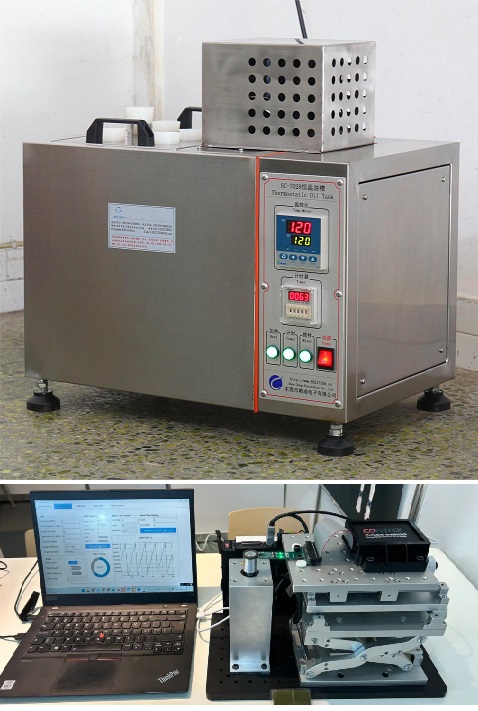
Quality Control and Testing
To guarantee that each product meets the standards of performance and durability, our product development manufacturing process integrates a series of quality control checkpoints:
Precision Dimensional Inspection: We utilize calibrated measurement tools to verify that all critical physical attributes—thickness, width, and length—adhere strictly to specified tolerances, ensuring perfect fit and function.
Magnetic Performance Verification: The magnetic flux density (surface Gauss) of each magnet is tested using state-of-the-art, calibrated equipment, guaranteeing that the magnetic field strength meets the required application parameters.
Magnetization Accuracy Control: For advanced applications, particularly those involving position sensing, we employ dedicated chip-based detection systems to verify the accuracy of pole dimensions and angular alignment, ensuring seamless integration with encoder ICs.
Adhesion and Bond Strength Validation: For products featuring rubber-to-metal bonding, we conduct standardized peel strength tests to confirm the integrity and long-term reliability of the material interface.
Long-Term Durability Simulation: We subject materials to accelerated aging tests that replicate harsh operational environments, such as prolonged exposure to high temperatures or immersion in automotive oils, to validate sustained performance over the product’s lifespan.
Let's Discuss Your Custom Rubber Magnet Needs
Custom rubber magnet lies in matching the material type (ferrite vs. NdFeB), magnetic orientation (isotropic vs. anisotropic), and physical specifications (thickness, width, surface treatment) to your specific application requirements.
At OTV, we specialize in developing custom rubber magnet solutions that meet your exact specifications. With years of experience in both rubber materials and magnetic technology, we understand the critical relationship between material composition, manufacturing processes, and real-world performance.
Thanks to contact us to discuss your requirements—from prototype development to mass production. Let’s work together to create the perfect custom rubber magnet solution for you.
FAQ
Q1: What's the difference between ferrite rubber magnets and NdFeB rubber magnets?
A: Ferrite rubber magnets are made from ferrite magnetic powder, offering good performance at lower cost—ideal for signage, crafts, and general holding applications. NdFeB rubber magnets use neodymium magnetic powder, providing significantly higher magnetic strength—typically 2-3 times stronger—but at higher cost. They’re used in specialized industrial applications where maximum holding force is needed in limited space.
Q2: Can custom rubber magnets be used outdoors?
A: Yes, but you need to select the right materials. For outdoor applications, specify rubber magnets with UV-resistant lamination and waterproof adhesives to prevent peeling, fading, and magnetic degradation over time. EPDM-based compounds offer excellent weather resistance, while NBR provides good oil resistance.
Q3: What's the maximum operating temperature for rubber magnets?
A: Temperature resistance depends on the binder material used. Standard NBR-based rubber magnets operate from -40°C to 120°C, while HNBR versions can extend the range to 160°C. For applications beyond these temperatures, other magnetic materials like samarium-cobalt may be needed.
Q4: How do I choose between isotropic and anisotropic rubber magnets?
A: Choose isotropic rubber magnets when you need uniform magnetic properties in all directions—such as for printed refrigerator magnets or promotional items that need magnetization after final forming. Choose anisotropic rubber magnets when you need maximum magnetic strength in a specific direction—they offer 2-3 times higher magnetic performance and are preferred for motors, sensors, and precision applications.
Q5: Can rubber magnets be printed with custom designs?
A: Absolutely. Custom rubber magnets can be manufactured with printable surfaces, allowing high-resolution graphics, logos, and text. Magnetic sheets and rolls can be compatible with printable vinyl, and finished products can include full-color printing with UV coating for enhanced durability. Be sure to specify your printing requirements during the customization process for best results.
Q6: What magnetization patterns are available for custom rubber magnets?
A: Various magnetization patterns can be tailored to specific application needs:
Single-side multi-pole: Magnetic force concentrated on one side (common for refrigerator magnets and signage)
Double-side multi-pole: Magnetic on both sides (for sealing strips and bi-directional holding)
Radial magnetization: For motor rotors and circumferential magnetic field applications
Custom pole spacing: Can be adjusted for specific sensor requirements or holding patterns